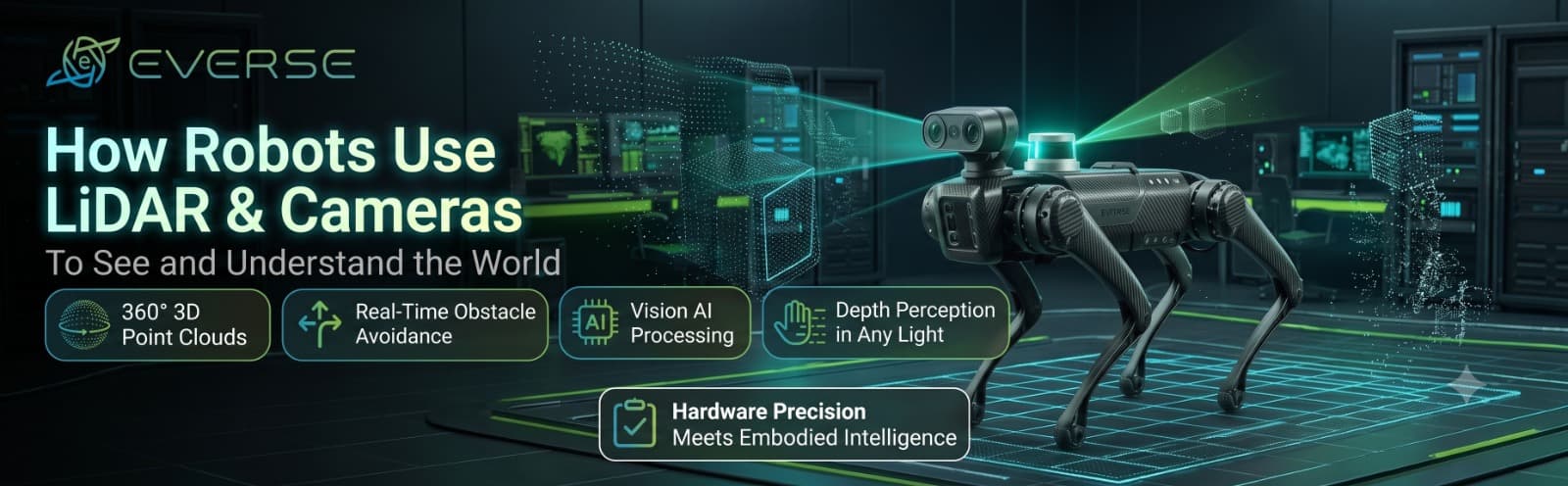
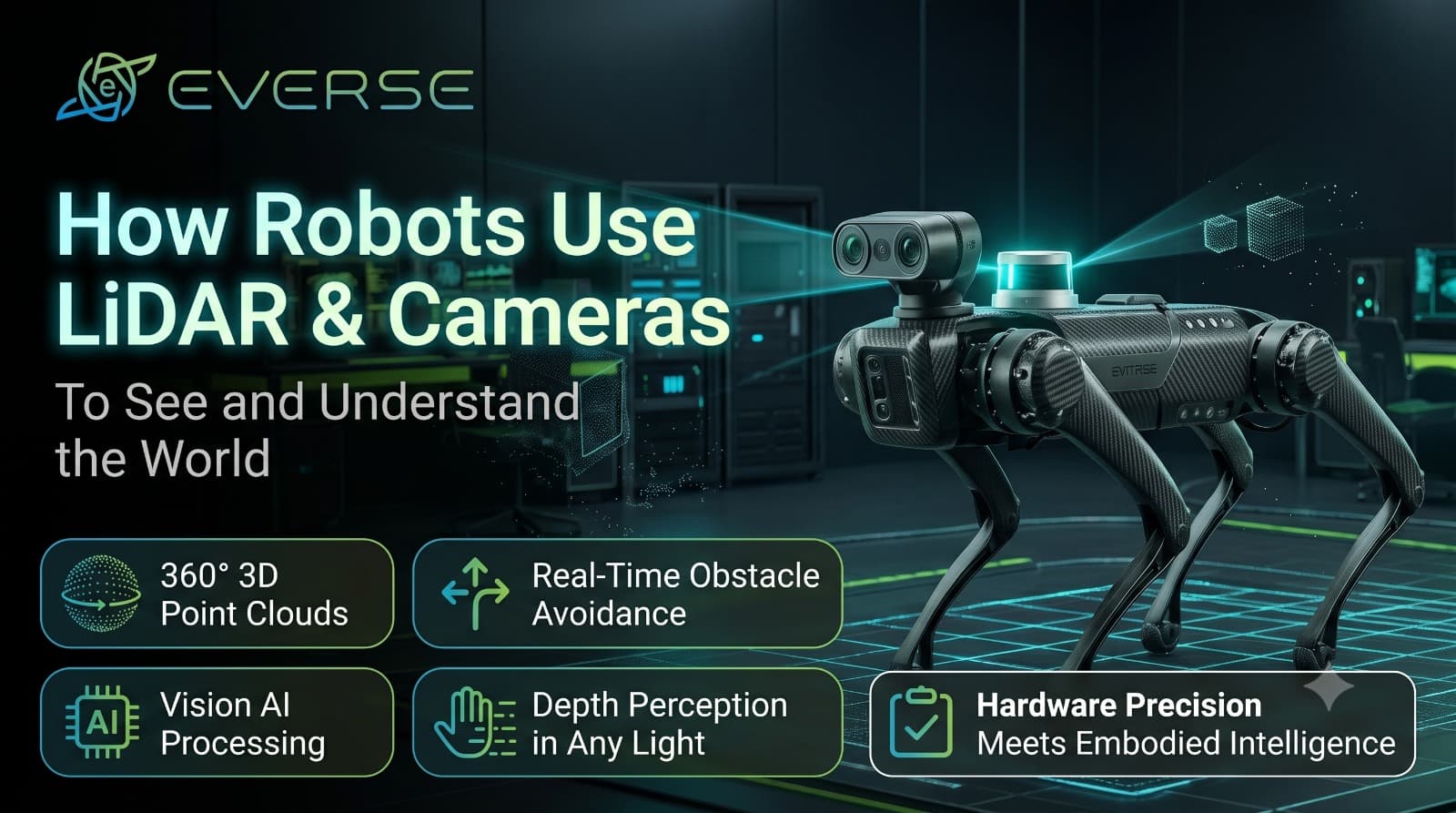
How Robots Use LiDAR and Cameras to Understand the World
For humans, understanding the world around us feels effortless. We can see an object, judge its distance, recognise a person, and decide where to walk almost instantly. Robots, however, need sensors and software to perform these same tasks.
Two of the most important technologies helping robots understand their surroundings are LiDAR and cameras. When combined with artificial intelligence and other sensors, they allow robots to perceive their environment, navigate spaces, avoid obstacles, and interact more intelligently with the world.
Robots don't see the world in the same way humans do. Instead, they collect information using sensors and process that information using onboard computers.
A camera can capture visual information such as colours, shapes, people, and objects. LiDAR, on the other hand, measures distances and helps create a three-dimensional representation of the environment.
The robot's software then processes this information to understand what is around it and decide how it should move or respond.
LiDAR stands for Light Detection and Ranging. It works by sending laser pulses toward the surrounding environment and measuring how long they take to return.
By processing thousands or even millions of these measurements, a LiDAR sensor can create a detailed 3D representation known as a point cloud.
This gives a robot valuable information about:
- How far objects are
- Where obstacles are located
- The shape of its surroundings
- The structure of rooms and spaces
- Changes in terrain and elevation
For a mobile robot navigating through an unfamiliar environment, this distance information can be extremely useful.
Cameras provide information that LiDAR alone cannot easily provide.
A camera can help a robot recognise visual characteristics such as colour, texture, patterns, and object appearance. With computer vision and AI, robots can identify objects, people, signs, doors, vehicles, and other features in their environment.
For example, a camera might help a robot recognise that an object in front of it is a person, while LiDAR can help determine exactly how far away that person is.
This combination gives the robot both visual understanding and spatial information.
LiDAR and cameras have different strengths.
A camera provides rich visual information but doesn't inherently provide the same direct depth measurements as LiDAR. LiDAR provides accurate distance information but doesn't capture visual details such as colour and texture in the same way.
Using both allows robots to build a more complete understanding of their surroundings.
This process is often called sensor fusion.
For example, imagine a robot approaching a chair. Its camera can help identify the object as a chair, while LiDAR can measure its position and dimensions. The robot can then use this information to determine whether it can safely move around it.
Sensors only collect information. The robot still needs software to interpret it.
Artificial intelligence and computer vision algorithms can process sensor data to recognise objects, identify obstacles, estimate movement, and understand the environment.
Modern robots can use this information for tasks such as:
- Object detection
- Person tracking
- Obstacle avoidance
- Path planning
- Navigation
- Scene understanding
- Hand and gesture recognition
The combination of better sensors and more capable AI is making robots increasingly adaptable.
Perception is closely connected to navigation.
A robot needs to know where it is, where obstacles are, and where it needs to go. Technologies such as SLAM (Simultaneous Localization and Mapping) allow robots to build maps of unfamiliar environments while simultaneously estimating their own position within those maps.
LiDAR and cameras can both contribute to SLAM systems.
This is particularly important for autonomous mobile robots, robot dogs, humanoid robots, and other machines that need to move through dynamic environments.
Robotic perception is already being used across many industries.
Warehouses: Robots can navigate aisles, identify obstacles, and transport goods.
Factories: Robots can move around industrial environments and interact with equipment.
Healthcare: Mobile robots can navigate hospitals and deliver supplies.
Agriculture: Robots can identify crops, obstacles, and changes in terrain.
Search and rescue: Robots can explore environments that may be dangerous for humans.
Humanoid robotics: Advanced robots use cameras, LiDAR, and other sensors to navigate spaces designed for people.
As sensors become smaller and AI becomes more capable, robots are gaining a much richer understanding of their surroundings.
Future robots may combine LiDAR, cameras, depth sensors, microphones, tactile sensors, and other technologies to create increasingly detailed models of the world.
The goal isn't simply to help robots “see.” It is to help them understand what they are seeing and make appropriate decisions.
This is one of the key steps toward truly autonomous robots that can operate safely alongside humans.
LiDAR and cameras represent two important pieces of modern robotic perception. LiDAR helps robots understand where things are, while cameras help them understand what those things look like. AI then brings these sources of information together to help the robot interpret its environment.
At Everse, we explore and provide advanced robotics and autonomous technology designed for research, education, development, and real-world applications. As robotics continues to evolve, technologies such as LiDAR, computer vision, and AI will play an increasingly important role in creating machines that can move, perceive, and interact with the world around them.
The future of robotics isn't just about building machines that can move. It's about building machines that can perceive, understand, and respond.