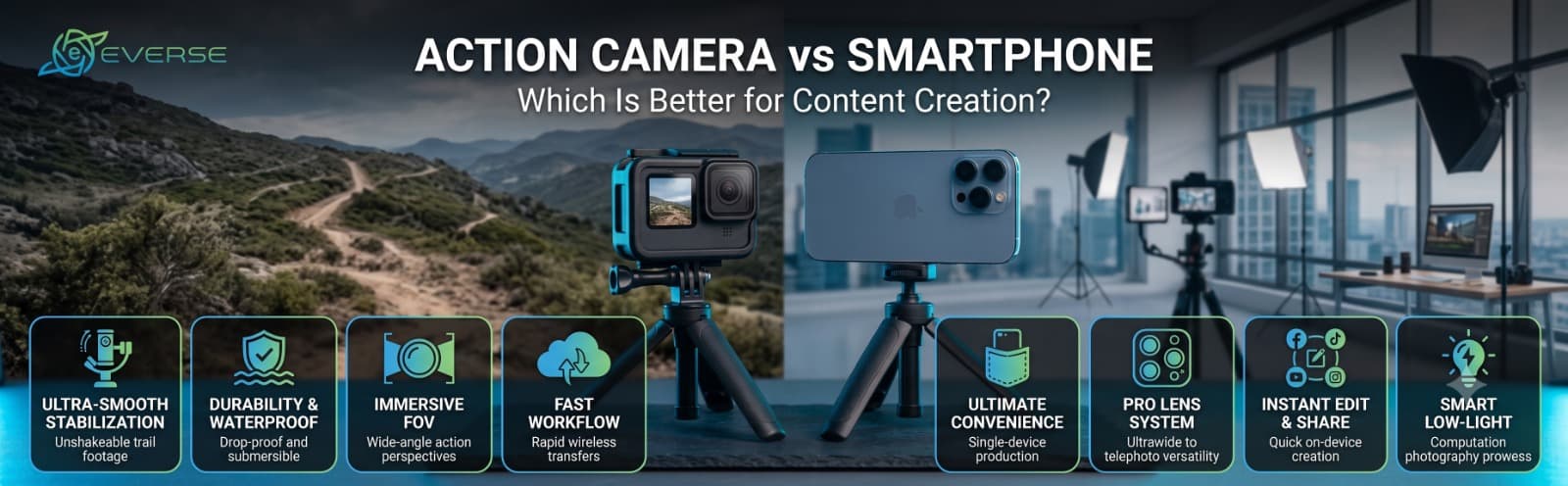
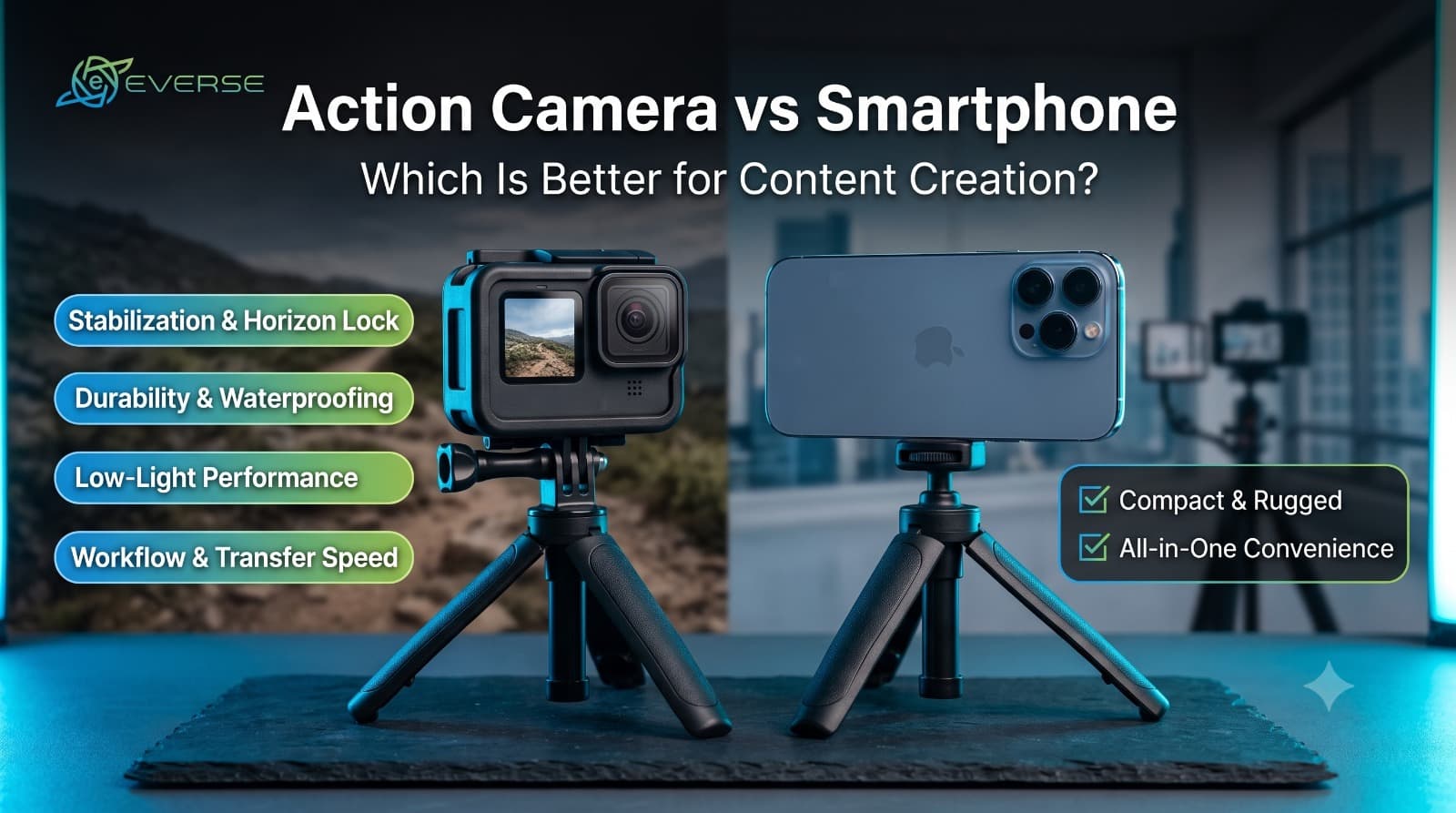
Action Camera vs Smartphone: Which Is Better for Content Creation?
Creating good content no longer requires a large camera setup. Today, a smartphone can record high-quality video, while compact action cameras offer dedicated features designed specifically for creators.
So, if you're starting a vlog, making travel videos, shooting reels, or documenting outdoor activities, which should you choose: an action camera or a smartphone?
The answer depends on how and where you plan to create.
Modern smartphones can produce impressive video with excellent colour, dynamic range, and computational image processing. Many flagship phones also support high-resolution recording and advanced stabilization.
Action cameras, however, are specifically designed for video. They typically offer wide-angle lenses, dedicated stabilization, high frame-rate recording, and shooting modes designed for fast-moving environments.
For everyday indoor content, a smartphone may be more than enough. For cycling, hiking, water sports, or other active situations, an action camera often has the advantage.
Movement is one of the biggest challenges when recording handheld footage.
Action cameras are built with stabilization systems designed to handle movement while walking, running, cycling, or participating in sports. This can produce smoother footage without requiring additional equipment.
Smartphones also offer excellent electronic and optical stabilization on many models, but their performance can vary considerably between devices.
If you're regularly recording while moving, an action camera can be a more convenient solution.
This is where action cameras have a major advantage.
Many action cameras are designed to handle demanding environments and may offer waterproofing, rugged construction, and protection against dust or impacts.
A smartphone is much more vulnerable to drops, water, sand, and other hazards, even when it has some level of water resistance.
For outdoor creators, having a camera designed to survive challenging conditions can provide much greater peace of mind.
Both devices are portable, but they serve different purposes.
You already carry your smartphone almost everywhere, making it the easiest camera to have available at any moment.
Action cameras are also extremely compact and can be mounted on helmets, bikes, vehicles, backpacks, tripods, and other equipment. This opens up shooting angles that would be difficult with a smartphone.
Smartphones can provide surprisingly good built-in audio, particularly in controlled environments.
However, dedicated action cameras can be paired with compatible external microphones or wireless microphone systems, giving creators greater control over their audio setup.
For professional content, though, a dedicated microphone is usually more important than simply choosing between the two cameras. Clear speech can make a significant difference to the final video.
Smartphones generally have an advantage in low-light photography and video, particularly premium models with larger sensors and sophisticated computational photography.
Action cameras use small sensors because they need to remain compact and lightweight. As a result, footage can become noisier in dark environments.
For daylight outdoor content, this difference is less significant. For indoor or nighttime shooting, a capable smartphone may be the better choice.
Action cameras are designed to be mounted.
You can attach one to a helmet, bicycle, car, chest mount, selfie stick, or other accessories. This makes them particularly useful for first-person and hands-free footage.
Smartphones can also be mounted using compatible accessories, but they are generally less practical for extreme or high-movement situations.
Smartphones have a major advantage when it comes to convenience.
You can record, edit, add music, create captions, and publish content from the same device. This makes smartphones particularly attractive for social media creators who want a quick workflow.
Action cameras usually require transferring footage to a smartphone or computer before more extensive editing.
However, many modern action-camera ecosystems offer companion apps that make transferring and editing footage much easier.
There isn't one universal winner.
Choose a smartphone if:
- You mainly create indoor or everyday content.
- You want an all-in-one device.
- You frequently edit and publish directly from your phone.
- You prioritise convenience.
- You don't regularly shoot in demanding environments.
Choose an action camera if:
- You create travel or adventure content.
- You record while cycling, hiking, or participating in sports.
- You need rugged and weather-resistant equipment.
- You want ultra-wide perspectives.
- You need flexible mounting options.
For many creators, the best solution may actually be both. A smartphone can handle talking-head videos, quick clips, and editing, while an action camera can capture dynamic outdoor footage.
The best camera isn't necessarily the one with the most specifications. It's the one that fits the way you create.
A smartphone offers convenience and excellent image processing, while an action camera provides durability, stabilization, mounting flexibility, and dedicated features for active shooting.
At Everse, we offer cameras, action cameras, microphones, gimbals, drones, and other content-creation equipment. Understanding your shooting style first can help you choose equipment that actually improves your workflow rather than simply adding more gear.